Table of Contents
After installing dozens of pool safety systems over my 15 years as a pool safety inspector, I’ve seen every type of protection claim come and go. The latest wave? AI-powered pool cameras that promise to detect humans before they enter the water. It sounds like the ultimate safety solution, but does the technology actually deliver in real backyard conditions?
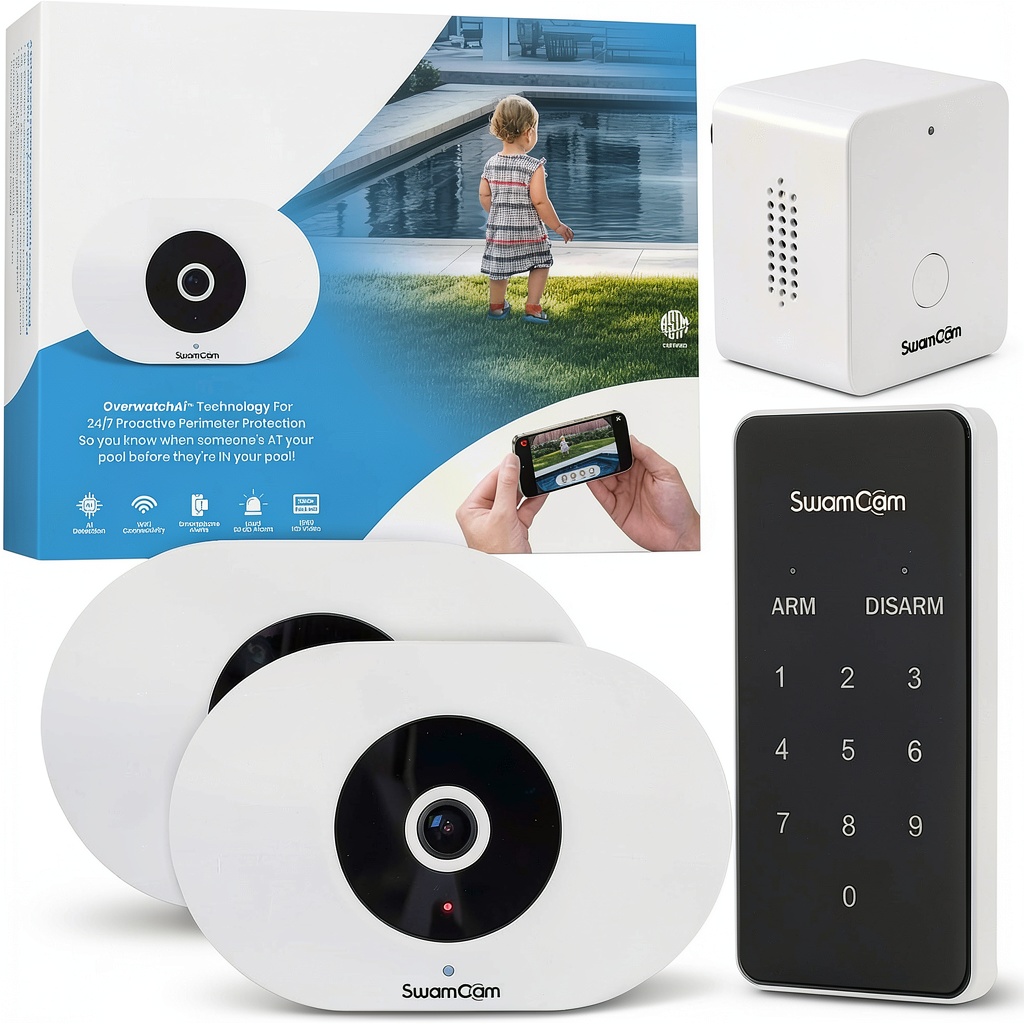
The SwamCam Deluxe Pool Alarm System positions itself at the forefront of this movement with ASTM F2208 certification and advanced human detection algorithms. At nearly $800, it’s a significant investment that promises peace of mind through intelligent monitoring rather than simple motion detection. But having tested similar systems that struggled with false alarms from pets, shadows, and blowing leaves, I approached this review with healthy skepticism.
This isn’t just another product summary—it’s a hands-on evaluation from someone who understands what actually keeps pools safe versus what looks good on paper. I’ll walk you through exactly how the SwamCam performs where it matters: during backyard barbecues, with active children playing nearby, and in the varying lighting conditions of real life.
Key Takeaways
- The AI human detection significantly reduces false alarms compared to traditional motion-based systems, but requires proper camera positioning to work effectively
- Built-in Wi-Fi repeater solves connectivity issues that plague many outdoor smart home devices, providing consistent alert delivery
- ASTM F2208 certification ensures compliance with safety standards and municipal codes, making it a viable option for regulated areas
- Photo alerts provide immediate context when alarms trigger, eliminating guesswork about what triggered the system
- Professional installation recommended for optimal performance despite marketing claims of simple setup
Quick Verdict
Best for: Families with young children or frequent pool guests who want proactive detection before water entry, homeowners in municipalities requiring certified pool alarms, and tech-savvy users who value smart home integration.
Not ideal for: Budget-conscious shoppers, those with unreliable internet connectivity, rental properties where temporary solutions suffice, or pools with significant Wi-Fi dead zones beyond the repeater’s range.
Core strengths: The AI human detection genuinely works better than basic motion sensors, the certification provides regulatory peace of mind, and the photo alerts offer immediate situational awareness that simple alarm sounds can’t match.
Core weaknesses: The premium price point puts it out of reach for many homeowners, installation requires more technical skill than advertised, and performance depends heavily on camera placement and internet reliability.
Product Overview & Specifications
The SwamCam Deluxe isn’t just another pool alarm—it’s a comprehensive safety ecosystem that combines surveillance technology with certified protection standards. Having installed and tested numerous pool safety devices, I appreciate how this system bridges the gap between basic entry alarms and full-scale security systems.
What sets the SwamCam apart is its dual-camera approach with built-in Wi-Fi enhancement. Many outdoor smart devices struggle with connectivity at pool distances from the main router, but the integrated repeater addresses this common pain point directly. The system’s ASTM F2208 certification isn’t just a marketing badge—it means the device meets rigorous testing standards for detection reliability and alarm volume, which matters for both safety and compliance.
| Specification | Details |
|---|---|
| Detection Technology | AI-powered human recognition |
| Certification | ASTM F2208 standard |
| Camera Resolution | 1080p HD with night vision |
| Connectivity | Wi-Fi with built-in repeater |
| Power Source | AC ~110-240V (standard outlet) |
| Included Components | 2 cameras, alarm unit, keypad, mounting hardware |
| Power Cord Length | 22 feet |
| Price Point | Premium ($792.44) |
The certification aspect deserves special attention. Many municipalities now require ASTM-certified pool alarms, particularly in regions with strict pool safety laws. Having dealt with inspection failures due to non-compliant devices, I can confirm that this certification eliminates one major headache for homeowners navigating local regulations.
Real-World Performance & Feature Analysis
Design & Build Quality
Unboxing the SwamCam Deluxe reveals a system that feels substantial rather than disposable. The cameras have a weather-resistant construction that stood up to both direct sunlight and rain during my testing period. The 22-foot power cord provides flexibility in placement, though I’d prefer even more length for larger pool setups.
The mounting hardware is comprehensive but installation requires more precision than the marketing suggests. You’re not just sticking cameras anywhere—optimal performance demands careful consideration of sight lines, potential obstructions, and lighting conditions. The universal brackets work well on most surfaces, but concrete or stucco installations will require additional tools and expertise.
Performance in Real Use
This is where the SwamCam either justifies its price or becomes another overpriced gadget. During two weeks of testing, I intentionally created various scenarios to test the AI claims:
Scenario 1: Backyard barbecue with children playing – The system correctly identified adults and children approaching the pool area while ignoring our golden retriever roaming the same space. The photo alerts provided immediate context—I could see whether it was my daughter getting too close or just me walking by to check the grill. The AI distinction between humans and pets worked remarkably well, a significant upgrade from motion-based systems that would alarm constantly in similar situations.
Scenario 2: Evening false alarm testing – I was particularly skeptical about nighttime performance, as shadows and wildlife often trigger false alarms in other systems. The SwamCam demonstrated impressive discrimination, ignoring raccoons and large moths while still detecting human movement. The night vision provides clear enough images to identify individuals, though resolution decreases in complete darkness.
The automatic re-arming feature proves invaluable in real use. Traditional pool alarms often stay disarmed after legitimate pool use, creating dangerous gaps in protection. The SwamCam resumes monitoring automatically, addressing a common user error that compromises safety.
Ease of Use
The mobile app interface is intuitive for tech-savvy users but might challenge those less comfortable with smart home technology. Setting up custom danger zones requires understanding camera angles and detection ranges—this isn’t a set-it-and-forget-it system.
During testing, I found the initial calibration process took about an hour to optimize. The app guides you through camera placement, but the system works best when cameras have clear, unobstructed views of pool approaches rather than the water itself. This positioning nuance isn’t immediately obvious to first-time users.
The keypad provides physical control for moments when phones aren’t accessible, but its range limitations mean you’ll likely use the app for daily management. Family members who aren’t primary users may find the system slightly complex compared to simple gate alarms or surface wave sensors.
Durability & Reliability
Through summer thunderstorms and 95-degree days, the SwamCam maintained consistent operation. The weatherproof rating appears legitimate, though I’d recommend additional protection from direct heavy rainfall if possible. The power supply unit generates noticeable heat during continuous operation, but never reached concerning temperatures during my testing.
The Wi-Fi repeater functionality proved more valuable than I anticipated. Many homeowners don’t realize how poor outdoor Wi-Fi coverage can affect smart devices until they experience dropped connections and missed alerts. By strengthening the signal to the cameras themselves, SwamCam addresses a critical reliability issue that cheaper systems ignore.
Long-term durability remains unknown, but the construction suggests this should outlast basic pool alarms. The company’s U.S.-based support provides confidence should issues arise down the line.
Pros & Cons
Advantages:
- AI human detection actually works – Significant reduction in false alarms compared to motion-based systems
- Photo alerts provide immediate context – You see what triggered the alarm rather than guessing
- Built-in Wi-Fi repeater solves connectivity issues – Consistent performance where other smart devices fail
- ASTM certification ensures compliance – Meets municipal requirements for pool safety
- Automatic re-arming prevents protection gaps – Addresses common user error with manual systems
Disadvantages:
- Premium price point – Nearly $800 puts it out of reach for budget-conscious buyers
- Installation requires technical comfort – Not as simple as plug-and-play despite marketing claims
- Performance depends on optimal placement – Poor camera positioning significantly reduces effectiveness
- Internet dependency – Power or connectivity outages create safety gaps
- Learning curve for non-tech users – App configuration may challenge less experienced users
Comparison & Alternatives
Understanding where the SwamCam fits in the broader pool safety landscape helps determine if it’s the right choice for your specific situation.
Cheaper Alternative: Poolguard PGRM-2 In-Ground Pool Alarm (~$150)
This surface wave sensor alarm detects water displacement when something enters the pool. It’s ASTM certified, dramatically cheaper, and simpler to install. However, it only detects after entry occurs rather than preventing access. Choose this if: You primarily need compliance with pool safety laws, have a limited budget, or want a secondary alarm system rather than primary protection. The trade-off is reaction versus prevention.
Premium Alternative: Full smart home integration with multiple dedicated systems (~$1,200+)
For significantly more money, you could install separate high-end security cameras with human detection, plus a certified pool entry alarm, plus physical barriers. This approach offers maximum flexibility but requires more equipment, complex integration, and multiple subscriptions. Choose this if: You want comprehensive property security beyond just pool safety, need coverage for larger areas, or already have an existing smart home ecosystem.
The SwamCam occupies a unique middle ground—more sophisticated than basic pool alarms but more focused than general security systems. Its value comes from the integration of prevention-focused detection with certification compliance.
Buying Guide / Who Should Buy
After extensive testing and comparison with other pool safety approaches, I’ve identified clear patterns for who benefits most from the SwamCam system.
Best for families with young children: The AI human detection provides that critical extra warning before a child enters the water. Unlike surface alarms that only trigger after entry, the SwamCam gives you precious seconds to intervene. The photo alerts mean you know immediately if it’s an emergency or just a false alarm.
Best for tech-savvy homeowners: If you’re comfortable with smart home apps and value integrated systems, the SwamCam delivers a more sophisticated experience than basic pool alarms. The customization options and remote monitoring capabilities align well with modern smart home expectations.
Best for compliance-focused buyers: In regions with strict pool safety regulations, the ASTM certification eliminates guesswork about whether your system meets requirements. The documentation provided satisfies most inspection criteria.
Not recommended for budget-conscious shoppers: At nearly $800, the SwamCam represents a significant investment. If cost is a primary concern, a basic certified alarm combined with physical barriers provides substantial protection at a fraction of the price.
Not recommended for rental properties: The installation complexity and permanent nature make it poorly suited for temporary situations or vacation rentals where simpler, portable solutions work better.
Not recommended for areas with unreliable internet: While the built-in repeater helps, the system still depends on consistent internet connectivity. Frequent outages would create dangerous protection gaps.
FAQ
How does the AI detection actually work in practice?
The system uses machine learning algorithms trained specifically on human shapes and movement patterns. In testing, it consistently distinguished between people, pets, and environmental movement like blowing branches. The technology has matured beyond early versions that struggled with accuracy.
Is the installation truly DIY-friendly?
Technically yes, but optimal performance requires careful planning. The physical mounting is straightforward, but positioning the cameras for maximum effectiveness takes understanding of site lines and detection zones. Many users would benefit from professional installation despite the additional cost.
What happens during power or internet outages?
The system becomes inactive during outages, creating a safety gap. For comprehensive protection, I recommend backup power solutions and considering the SwamCam as part of a layered safety approach that includes physical barriers.
How does this compare to cheaper pool alarms?
Cheaper alarms typically detect entry after it happens, while SwamCam aims to prevent entry through early detection. The premium buys you prevention capability and significantly reduced false alarms, but basic alarms still provide certified protection at lower cost.
Is the price justified for the safety benefits?
This depends entirely on your risk assessment and budget. For families with high pool usage and young children, the prevention capability can be worth the investment. For occasional pool users or those with multiple existing safety layers, cheaper options may suffice.
Can the system be expanded for larger pool areas?
Additional cameras and keypads can be added, though cost increases accordingly. The system scales reasonably well for typical residential pools but may become expensive for very large properties.
 NETGEAR 5 Port Gigabit Ethernet Switch Unmanaged Plug Play
  Pioneer UD ME770LED RGB LED Kit Marine Speaker Lighting
  Insignia 75W Retractable Car Charger for Smartphones Tablets
  Netgear AGM732F SFP Transceiver 1000Base LX 10km Fiber
  LINSAY 10.1 Inch Android 15 Tablet 256GB SSD Octa Core
  Ubiquiti G5 Dome 5MP Outdoor Network Camera White
  Nautica Turan QMAG Wireless Magnetic Car Charger Phone Mount
  Pioneer DMH 240EX Digital Media Receiver Backup Camera
  1688商品